Control the building systems you already have—one problem at a time.
For property owners and managers, IOC adds retrofit control, local continuity, recovery, and operating proof to the circuits, controllers, and equipment already inside the building.
Start with one recurring problem—lighting that wastes energy, irrigation that is hard to manage, equipment that keeps freezing, or operation that remains unclear. IOC identifies the physical responsibility behind it, installs the appropriate interface, commissions the local rules, and verifies the result.
At 8600 Glenoaks, a Smart Light Management deployment covering 256 fixtures reported more than 50 percent energy reduction and received 2024 recognition through the U.S. Department of Energy Integrated Lighting Campaign. Review the evidence and claim boundary →
What problem keeps repeating at the property?
IOC begins with a burden the owner, manager, resident, technician, gardener, or service team already recognizes. The first installation is built around that real operating need.
Lights run too hard for too long.
Control garage, hallway, stairwell, parking, pole, and exterior lighting at the circuit level. Apply useful schedules and staged output, preserve required visibility, and verify what changed.
Controllers are scattered and hard to manage.
Give managers and field teams better control over schedules and zones without depending on weak property Wi-Fi or repeated trips to controller boxes.
A frozen device creates another site visit.
Add bounded reset and recovery to supported routers, gateways, readers, cameras, intercoms, and other equipment—and verify whether normal service returned.
The right intervention is not yet clear.
Observe operating state, runtime, available electrical measurements, schedules, history, and anomalies first—then let the record determine whether control, recovery, maintenance, or no wider intervention is justified.
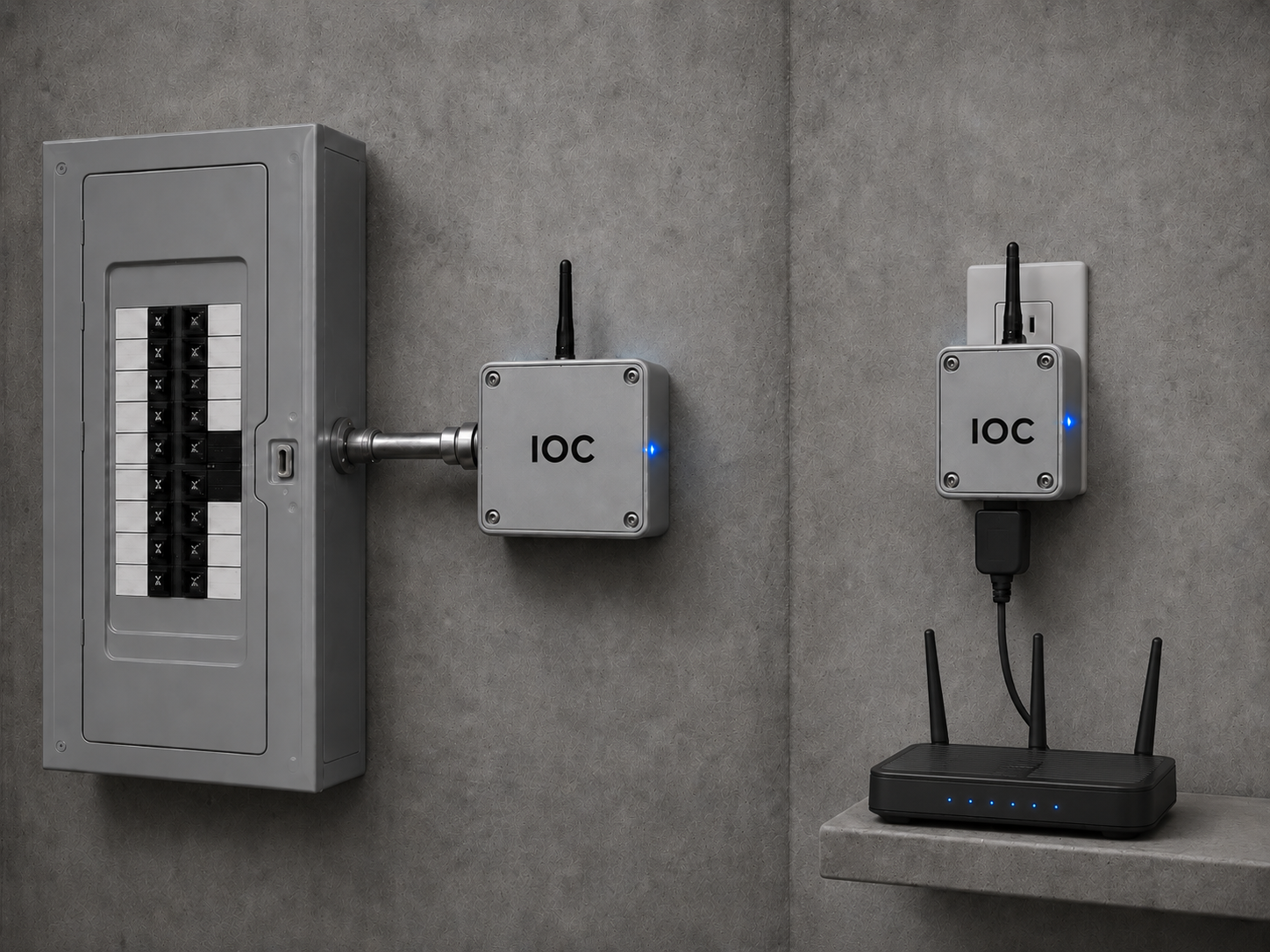
IOC enters at the physical responsibility—not through a whole-building replacement.
IOC works with the systems already in place. The first interface enters at the circuit, controller, plug-load path, zone, gateway, pump, or equipment point involved in the recurring burden.
The governed boundary is the continuing responsibility being served. The local node is a replaceable mechanism that carries its commissioned rules, present state, continuity behavior, restoration obligations, and evidence.
See the hardwired, reset/recovery, and irrigation forms →
Turn one recognized burden into a bounded first project.
We review the recurring burden, identify the physical responsibility involved, and determine whether a focused first deployment is appropriate.
Before work begins, the owner receives a clear scope, application limits, installation path, operating objective, evidence plan, and price.
Review the burden and the physical context.
Share a short description and, when authorized, relevant photos, bills, schedules, equipment information, or operating history.
Define and price the first bounded scope.
IOC confirms the suitable interface, field responsibility, local rules, installation conditions, expected evidence, and what remains outside the project.
Install, activate, operate, and verify.
The approved field work is completed, IOC commissions the responsibility, and the resulting operation and evidence decide whether anything should be repeated.
What you receive
A working retrofit deployment for the selected responsibility, commissioned local behavior, operating visibility, an evidence record, and a result reviewed at the correct claim level. The first project is designed to reduce uncertainty—not force a building-wide reconstruction or automatic expansion.
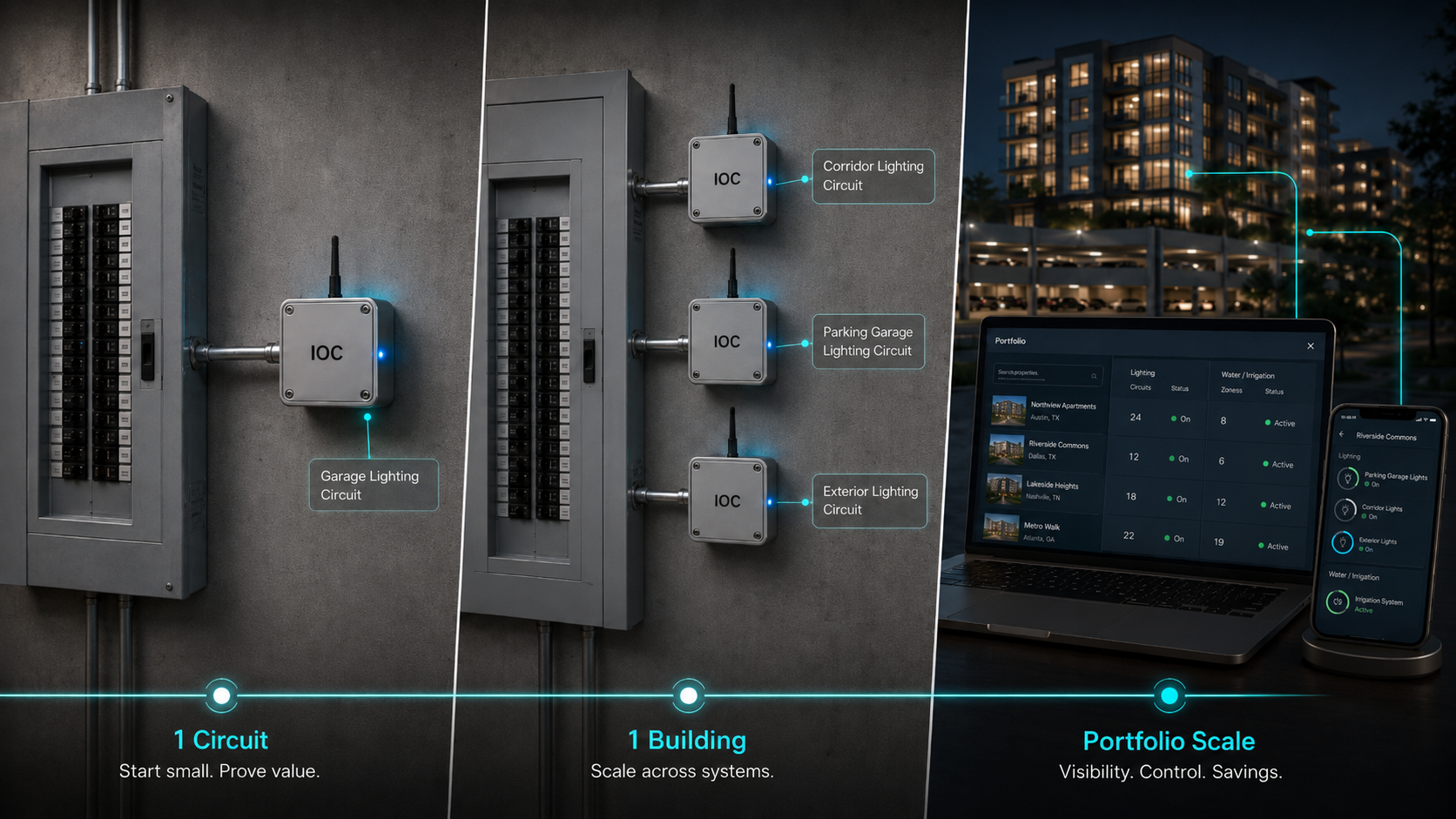
The problem in one building is often repeating across the portfolio.
One garage may be overlit, but the same schedule may be running in ten garages. One frozen gateway may reveal a recurring recovery burden across many properties. One difficult irrigation controller may expose the same operating gap throughout the portfolio.
IOC lets the owner solve the first case, verify the result, preserve the operating knowledge, and then repeat the proven configuration where the same responsibility appears again.
Begin with property value. Then choose the depth you need.
Home stays practical. The mechanism, evidence, category placement, wider vision, publications, field participation, and institutional formation each continue through their own deliberate doorway.
Property owners and managers
See how IOC creates recurring savings, remote control and recovery, clearer maintenance, fewer avoidable trips, stronger operating visibility, and portfolio repetition after proof.
Follow Identify → Govern → Answer → Continue + Restore → Prove at one ordinary physical responsibility.
See the MechanismSee what has been demonstrated, how claim levels remain separate, and why one verified boundary earns the next.
Review the EvidenceSee where IOC sits beneath BMS, EMS, VPP, DERMS, smart panels, specialized controllers, and AI without replacing their useful roles.
Place IOC in the StackSee why supply learned to coordinate while ordinary demand remained fragmented—and how participating buildings can complete the physical machine.
See the Larger VisionChoose depth, field responsibility, or institution-building without collapsing them.
Start Here and the Library carry the reading paths. Partners & Installers carries distributed field work. Help Build carries defined Platform Institution and stewardship-formation responsibilities.
Show us one problem that keeps repeating.
Tell us what keeps wasting energy or water, requiring a site visit, losing connection, following the wrong schedule, failing to recover, or operating without a clear record. We will identify the first physical responsibility to address—and whether the same pattern is repeating elsewhere in the portfolio.