Cut recurring building waste in hours—not months.
IOC starts with one recurring property burden—wasted electricity or water, repeated site visits, equipment that keeps failing, or a portfolio operating blind spot—and adds a compact local operating point to the infrastructure already there.
The first job is not to automate the whole building. It is to find the physical responsibility where a measurable correction can improve operations, verify the result, and earn the next step.
At 8600 Glenoaks, the managed lighting deployment covered common-area and exterior fixtures and received 2024 recognition through the DOE Better Buildings Integrated Lighting Campaign. Company operating records separately indicate approximately $477 in monthly savings over about three years, totaling more than $18,000.
Start where the building may be bleeding the most.
In many multifamily, high-rise, HOA, hotel, and commercial properties, the parking garage contains one of the largest clusters of continuously operating and controllable common-area loads.
Lighting, ventilation, charging, gates, pumps, cameras, access equipment, and communications may all be operating in the same physical field—often with different schedules, vendors, and levels of visibility.
Garage lighting that stops running at unnecessary output.
IOC can reduce lighting during low-occupancy hours through approved stages rather than treating the circuit as only on or off.
- Preserve an approved safe minimum
- Return to full output when required
- Continue locally if communications are unavailable
- Compare before-and-after operating behavior
Large fan loads deserve an operating review.
Where the existing fan, VFD, controls, sensors, and safety requirements are suitable, IOC can evaluate whether continuous or excessive operation can be reduced safely.
- Review schedules and actual operating levels
- Identify condition-based opportunities
- Preserve minimum ventilation and safety requirements
- Stage restoration instead of creating a rebound
Stop sending people for simple, repeated equipment problems.
Selected gates, access systems, gateways, intercom support paths, cameras, EV-support equipment, pumps, and communications devices may benefit from monitoring or a defined recovery path.
- See repeated conditions and failures
- Perform an authorized restart where appropriate
- Verify whether service returned
- Reserve site visits for hands-on work
Small physical nodes added to the systems already in the building.
Property teams should not have to imagine an abstract platform. IOC is physical retrofit hardware connected at the existing circuit, controller, or equipment power path, with a managed property and portfolio interface above it.

Installed beside the existing electrical point.
The building keeps its existing fixtures and circuit. The compact IOC node adds scheduling, staged control, monitoring, local operation, and operating history where the scope supports it.
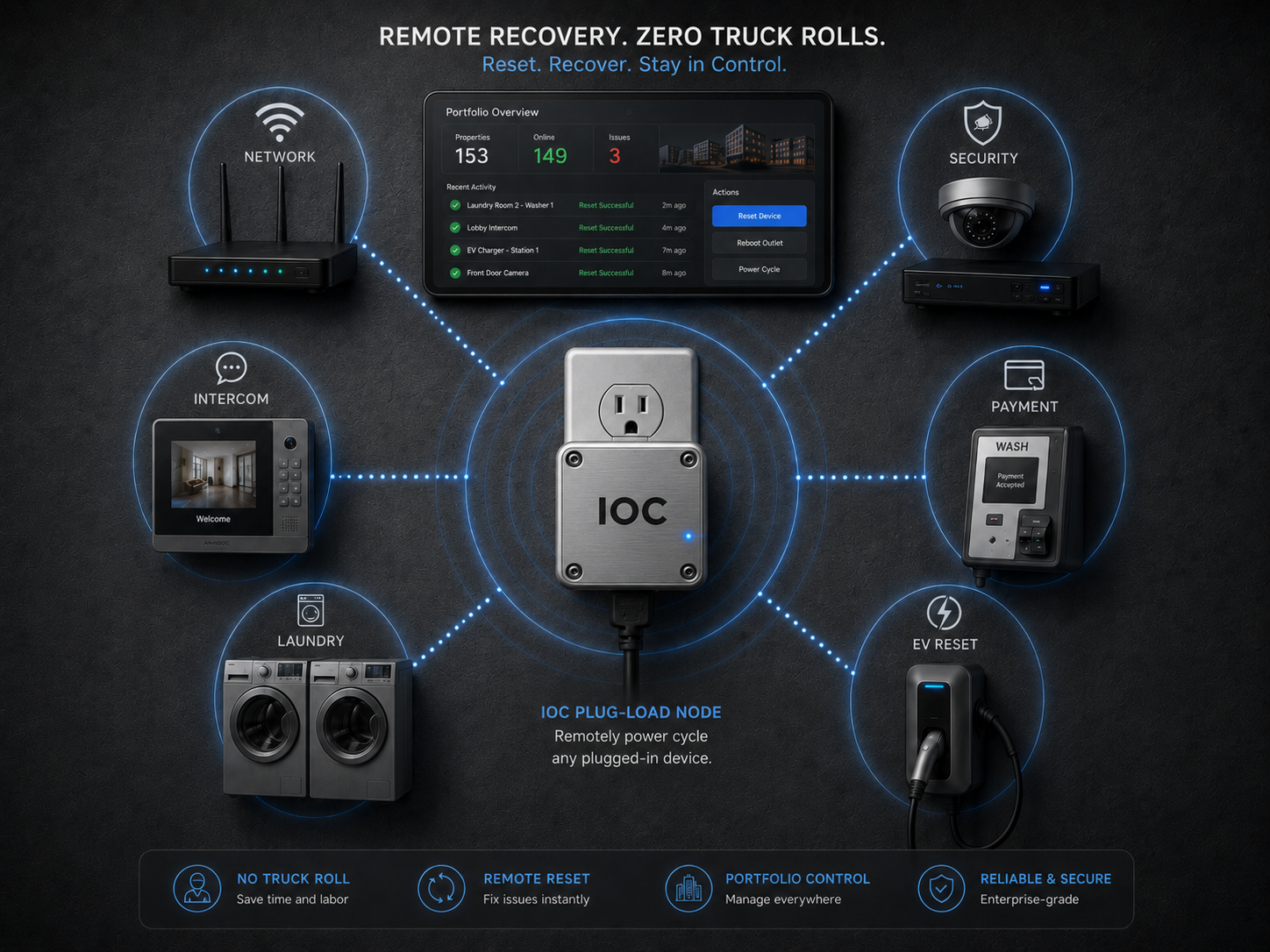
Inline with selected equipment that keeps freezing.
The recovery node can provide a controlled restart and result check for supported equipment, helping the property avoid dispatching someone for every simple failure.
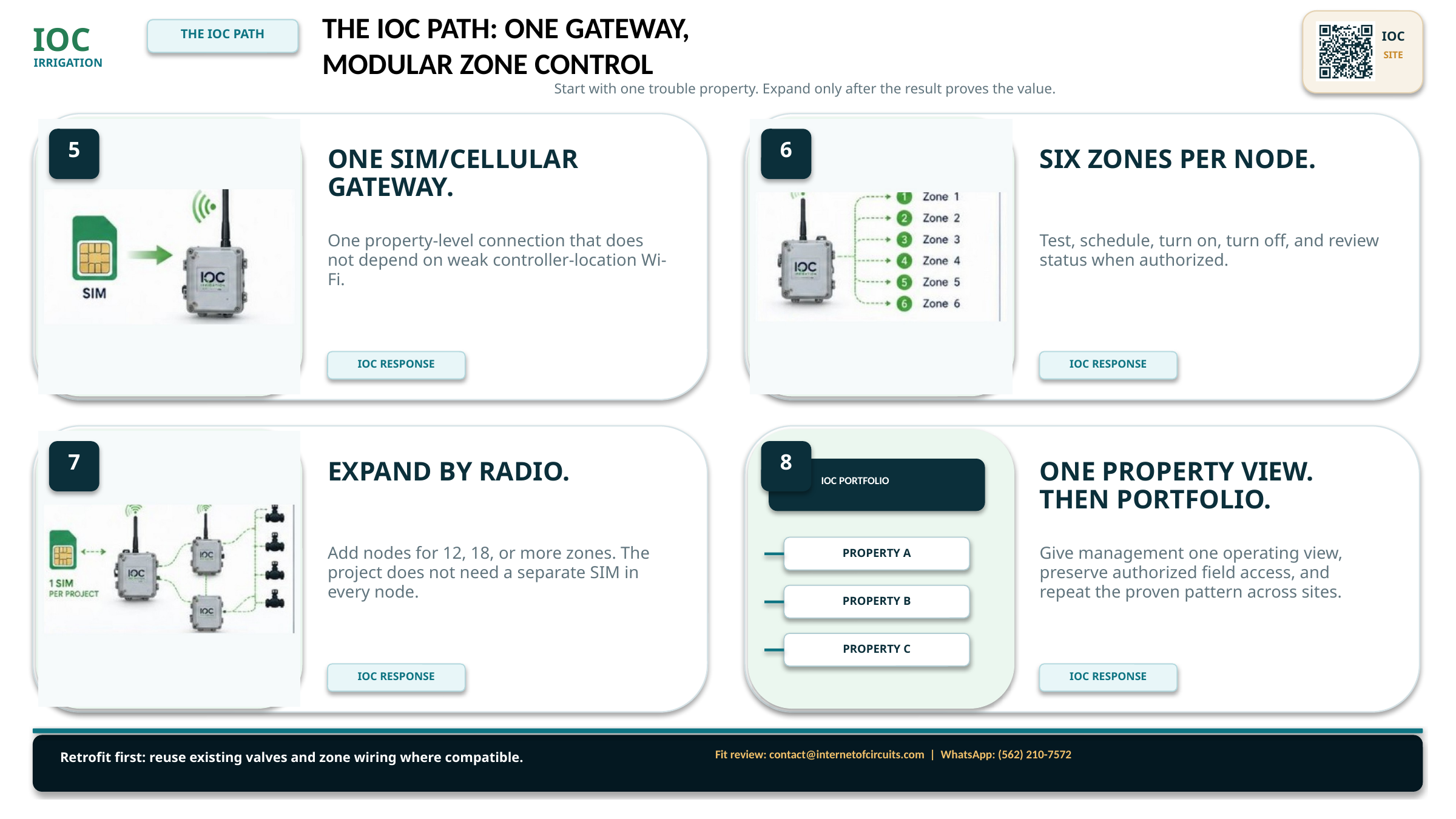
Existing valves and wiring become office-visible.
One cellular gateway and modular six-zone nodes connect compatible existing irrigation wiring to local schedules, authorized field access, history, and portfolio management.
See the property path before the details.
The briefing introduces the practical sequence: choose one recurring burden, enter at the physical point, verify the operating and financial result, and let evidence decide what should follow.
Not one trick. Several recurring costs corrected at the physical source.
The strongest result may begin with electricity or water, then extend into labor, downtime, maintenance, and portfolio operation.
Reduce unnecessary runtime and output
Lighting, irrigation, pumps, and other suitable systems stop operating harder or longer than the approved property need.
Avoid repeated site visits
Selected equipment can be seen, tested, or recovered remotely before someone is dispatched.
Preserve operating knowledge
Schedules, changes, operating history, and results become visible beyond one timer, controller box, vendor, or person’s memory.
Repeat proven policies
Comparable properties can receive approved schedules and operating patterns after site verification, while local exceptions remain local.
Savings do not stop at the utility bill.
When the owner pays the recurring expense, durable net savings can improve net operating income. The same improvement may support property value when it is persistent, documented, and recognized in underwriting.
Choose the problem already costing the property money or attention.
The first package should be small enough to approve, complete enough to matter, and measurable enough to decide what comes next.
Lighting first, larger loads evaluated
Start with high-runtime garage lighting, then review ventilation, EV-support, gates, pumps, and selected equipment.
- Fast measurable lighting entry
- Ventilation and VFD review where suitable
- Monitoring and recovery points
Office visibility without erasing field access
Use existing valve wiring, store schedules locally, and connect the gardener, office, and owner.
- Six-zone modular control
- Cellular gateway and radio expansion
- Schedule testing, history, portfolio schedules, and planned Rain Action holds
Reduce simple manual-reset visits
Selected gateways, access systems, intercoms, cameras, EV-support equipment, and other devices receive a defined recovery path.
- Authorized interruption and return
- Recovery verification
- Repeated-failure visibility
Measure before automating when the burden is unclear
Selected circuits can begin with visibility so the owner can identify runtime, operating patterns, and where a control or recovery investment is actually justified.
- Current, runtime, or energy visibility
- Before-and-after comparison
- Evidence supporting the next decision
One compact physical point—not a building renovation.
IOC does not require the property to replace every device or wait for a future whole-building controls project. It enters where a recurring cost, failure, or operating burden can be corrected and measured.
At each deployed boundary, the installed IOC node retains the approved local operating behavior. The physical responsibility and its operating record remain the continuity anchor even when hardware is later serviced or replaced. The cloud and dashboard provide management and visibility, but they are not required for every ordinary action.
From property walk to working operating point.
Most first IOC entry points are planned in hours, not construction months, depending on access, existing condition, scope, equipment, and the qualified trade required.
The person paying for the water should not be blind to the system using it.
Traditional irrigation control is centered on the field worker and controller box, while financial and operating responsibility sits with the owner and management office. IOC connects those realities without removing useful field access.
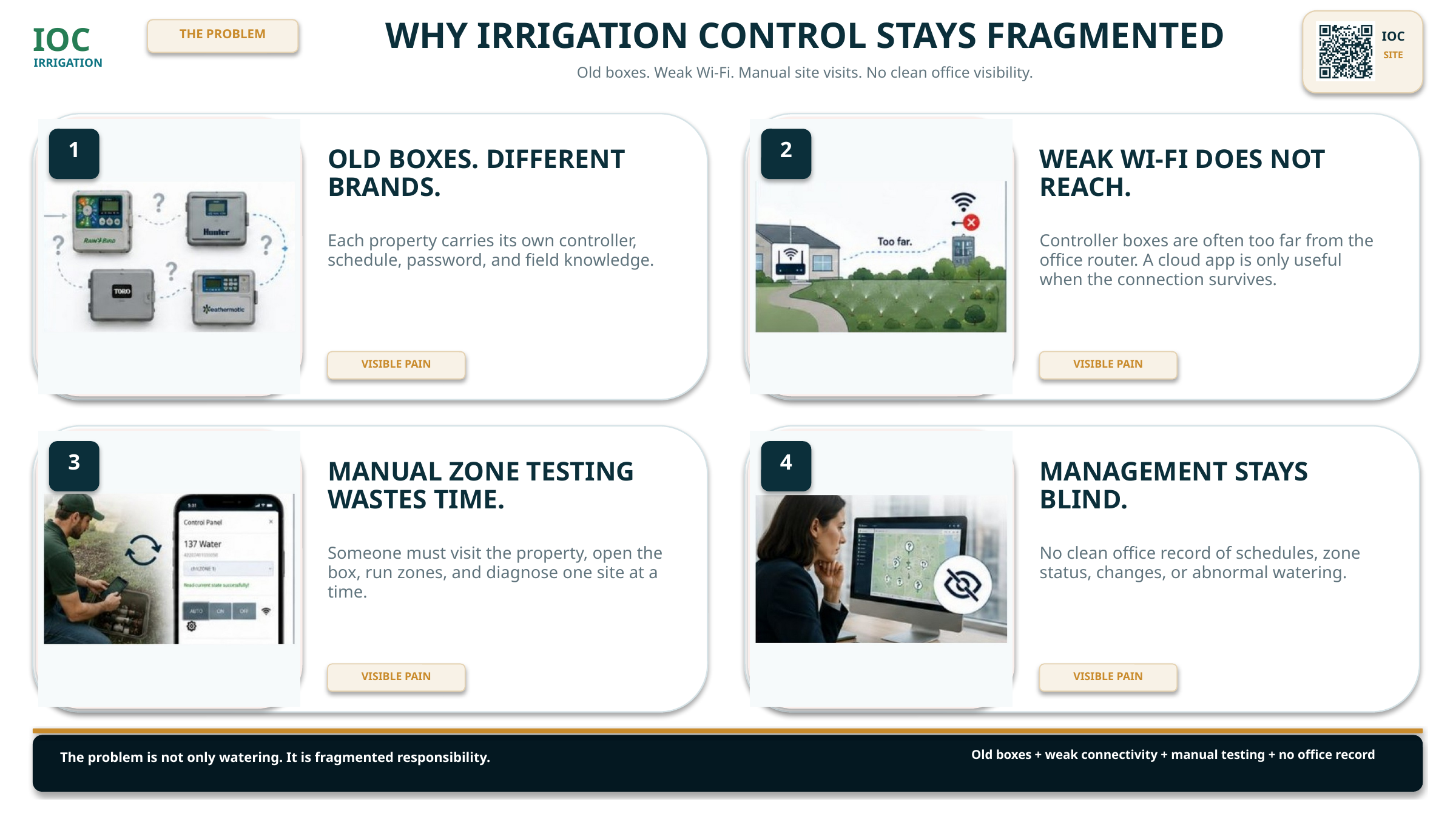
Before: management pays while knowledge remains scattered.
- Different controller brands and schedules beyond reliable property Wi-Fi
- Manual visits and repeated walking for diagnosis and testing
- No coherent office record of changes, activity, restoration, or recurring problems
After: one owner-visible and field-operable layer.
- One SIM/cellular gateway with modular six-zone nodes
- Each node retains and executes its own complete schedule offline
- Office visibility, authorized gardener access, schedule testing, history, portfolio repetition, and planned Rain Action weather holds
One property. Six zones. One clear price.
Begin with one qualifying property, connect the field system to the management office, and make the first operating result visible before expanding.
Installation + activation
One six-zone IOC master/gateway, installed, connected to compatible existing valve wiring, configured, and commissioned.
Govern, see, support, coordinate
Property access, schedules, remote testing, operating history, updates, and routine support. Rain Action is introduced as the developing weather-hold capability is activated.
Qualifying standard properties
For ten or more committed qualifying properties, plus $49 per month per activated property.
What the standard first property receives
- One six-zone IOC master/gateway supporting up to six compatible existing irrigation zones
- Cellular connection, local schedule storage, and radio-linked expansion capability
- Office visibility with authorized gardener or maintenance access
- Activation, commissioning, schedules, remote testing, history, updates, and routine support; planned Rain Action is added as activated
Managed layer now. Protection layer when needed.
$49 means govern, see, support, and coordinate. It does not claim verified flow measurement, continuous leak monitoring, or active physical protection.
Future Water Protection adds separately scoped sensing, verification, intervention, and protection capabilities.
Genuine field repairs, incompatible conditions, added zones, or added hardware are identified and quoted separately before approval.
Start with one property fit review. IOC confirms compatibility, exact scope, customer terms, and any field exceptions before approval.
Prove it once. Repeat it across the portfolio.
Your portfolio should not depend on hundreds of separate timers, controller boxes, logins, schedules, vendor notes, and people’s memories. IOC organizes the managed relationship by activated property rather than fragmenting it into a separate subscription for every circuit, zone, or recovery point.
The internet can go down without erasing the property’s operating schedule.
IOC keeps approved behavior at the deployed property boundaries. Lighting and irrigation do not need a live cloud connection for every ordinary action.
Send the simplest evidence already available.
A useful first conversation does not require a full engineering package. A few photos, the recurring burden, the current schedule or response, and a recent bill or baseline are often enough to identify the next question.
Property Brief
A concise owner and management overview.
Open the Brief →Field Proof
Review Glenoaks, current field evidence, maturity, and claim limits.
See the Proof →IOC Library
Continue into owner economics, the participating building, and the wider architecture.
Browse the Books →Client Portal
Existing clients can access their operating dashboard.
Client Login →IOC reviews site fit, authority, safety, code, communications, equipment suitability, field work, commissioning, scope, price, and evidence before a project is approved.
Show us where the property keeps wasting money, water, time, or attention.
Tell us what runs too long, wastes electricity or water, repeatedly loses connection, requires manual restarting, follows the wrong schedule, or appears across multiple properties. We will identify the first physical responsibility worth reviewing and the evidence that should decide what follows.