The smart building can be commanded. The participating building can answer.
IOC gives each physical responsibility enough identity, authority, local truth, continuity, restoration, and proof to participate safely.
A building is not one load. Lighting, irrigation, ventilation, charging, pumps, access, and recovery paths serve different purposes and carry different limits. IOC places a common operating grammar at those physical boundaries so each responsibility can answer according to what it is, what it serves, and what is lawful now.
Reachability alone does not establish served purpose, authority, safe limits, or restoration.
The receiving boundary still needs to evaluate present truth and decide what participation is permitted.
IOC carries the return path inside the operating relationship rather than treating it as an afterthought.
Five movements carry a physical responsibility from identity to proof.
The public sequence is simple enough to follow and deep enough to preserve the architecture. Each movement contains more detailed rules, but the operating path remains the same across lighting, irrigation, ventilation, charging, pumps, recovery, and other physical responsibilities.
Identify
Know which physical responsibility exists, where it belongs, what it serves, and which history follows it.
Persistent boundary identity, served purpose, place, and continuity.Govern
Place authority, present condition, dynamic criticality, safe limits, timing, and restoration obligations.
The wider condition is heard without automatically becoming physical permission.Answer
Act, reduce, delay, partially participate, monitor, recover, offer an alternative, or refuse with cause.
The answer returns truthful capability instead of blind obedience.Continue + Restore
Preserve lawful local behavior through communication loss and carry the ordered return path inside the event.
Offline continuity and restoration are part of the architecture, not emergency patches.Prove
Record what happened, why, for how long, what restored, and what physical or operational value followed.
Evidence closes the event and earns the next boundary.One condition reaches the building. Each responsibility answers according to local truth.
The higher layer expresses the objective. The participating building translates it into differentiated physical answers without erasing purpose, protection, refusal, continuity, or restoration.
The portfolio approaches an afternoon demand target.
The higher layer can express the objective, timing, requested magnitude, fallback, and proof requirement. It does not need to become the minute-by-minute source of physical continuity.
Stages down within a protected visibility floor and reports the resulting state.
Offers bounded capability only while contaminant, equipment, and local safety conditions remain inside the approved envelope.
Pauses eligible sessions, preserves deadlines, and returns through a sequenced recovery plan.
Remains protected because security and continuity make the requested reduction ineligible.
Retains its local schedule and any temporary rain or owner hold rather than inheriting an unrelated electrical command.
Records action, limitation, refusal, duration, ordered restoration, and the evidence available from each boundary.
Composite operating illustration. It demonstrates how one grammar can govern unlike responsibilities; it does not assert that every embodiment shown has already been deployed together at one site.
IOC changes form to meet the responsibility—not the other way around.
A lighting circuit, a frozen gateway, and a six-zone irrigation controller do not need the same terminals or enclosure. They do need the same coherent operating relationship: identity, authority, local evaluation, continuity, restoration, and proof.
The node is the local carrier of one governed responsibility.
The physical interface changes with the circuit, plug load, controller, valve group, sensor, or support device. The common grammar keeps unlike forms coherent inside one building and portfolio record.
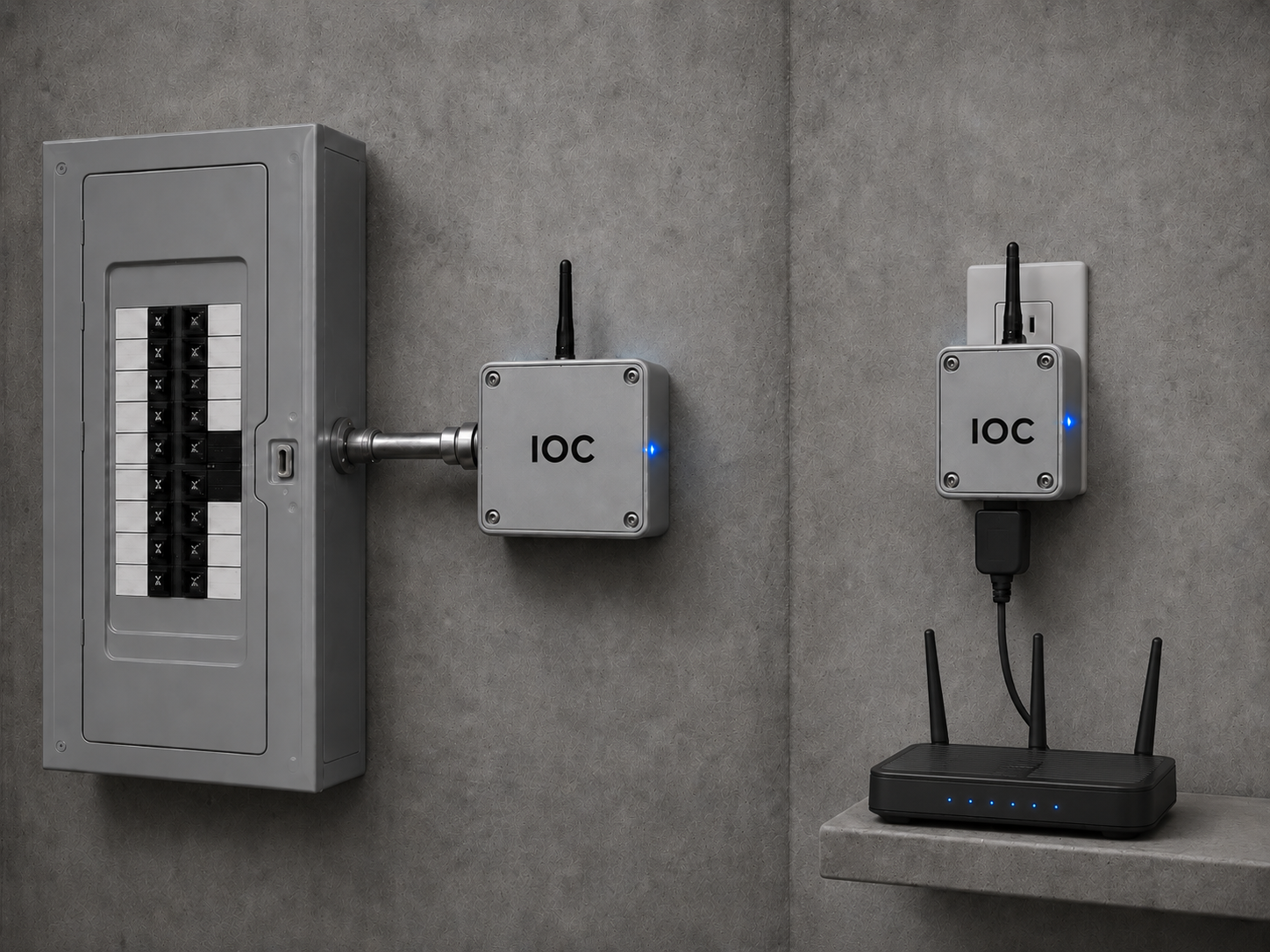
Lighting and suitable panel-served responsibilities
The circuit-level form is added beside existing infrastructure to observe, schedule, stage, limit, monitor, continue locally, restore, and return evidence.
- Garage, hallway, parking, pole, and exterior lighting
- Selected pumps, heaters, chargers, and other approved paths
- Single-channel or application-specific hardwired forms
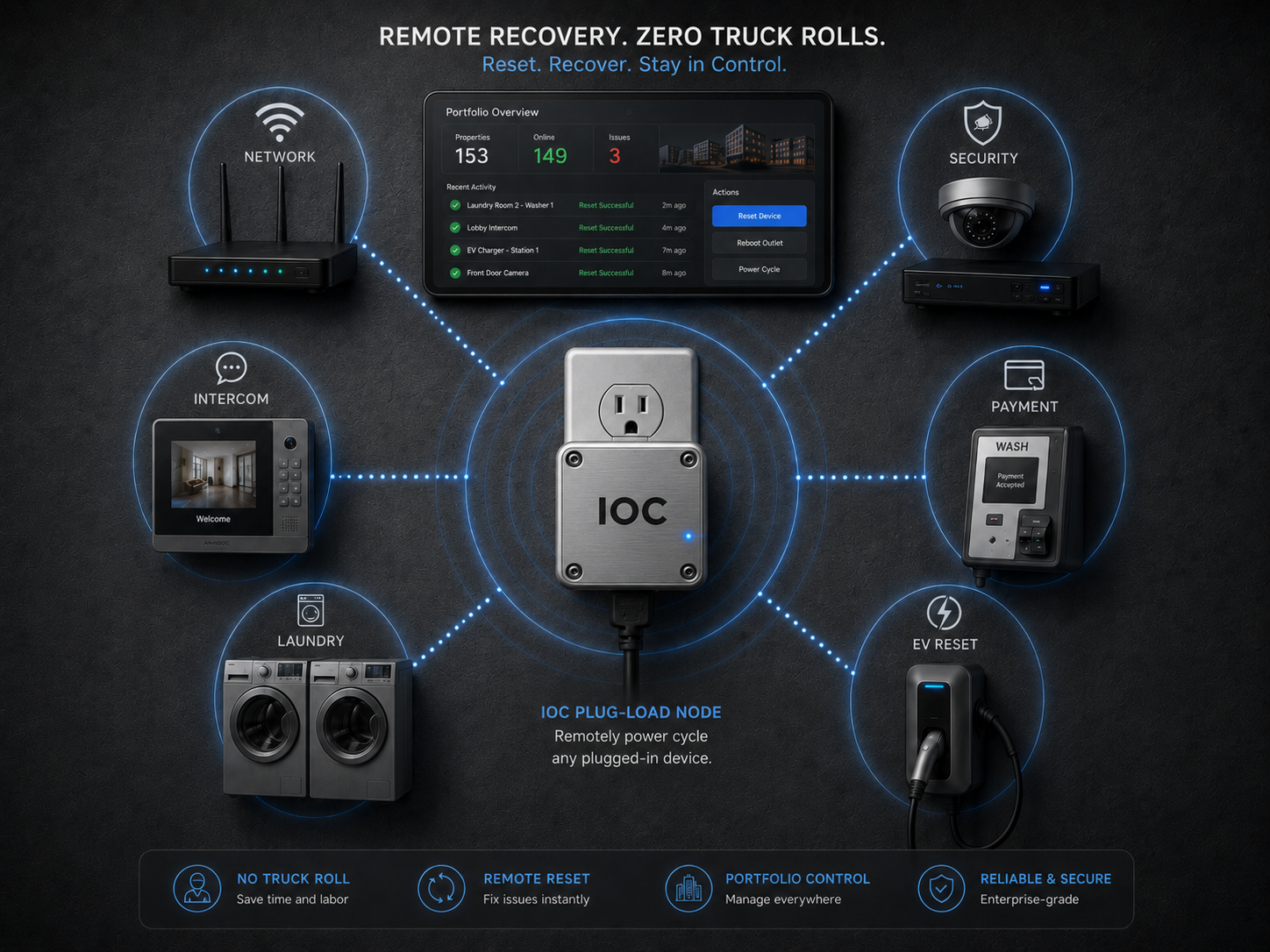
Supported equipment that freezes, disappears, or needs a controlled restart
The recovery form sits inline with selected equipment and carries a bounded interruption, cooldown, return, verification, and escalation path instead of treating reset as an unrecorded manual act.
- Routers, gateways, readers, intercoms, and controllers
- Remote recovery before another avoidable site visit
- Reset limits, recovery verification, and repeated-fault evidence
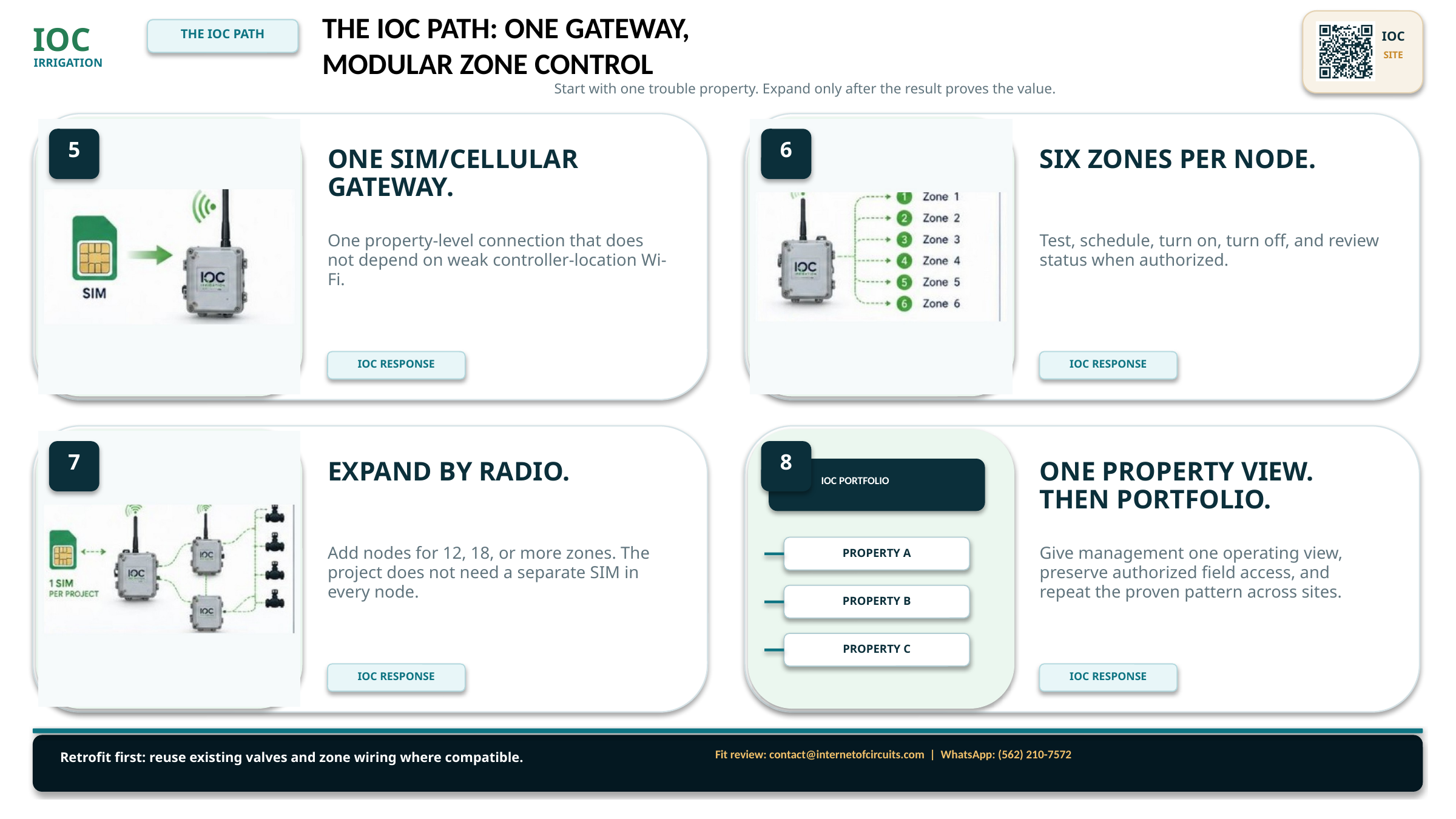
Irrigation nodes with complete local six-zone schedules
The irrigation form changes the output interface, not the governing logic. Each six-zone node stores and executes its own full schedule locally while the gateway routes updates, visibility, and portfolio coordination.
- Six independently identified valve or zone responsibilities per node
- Local schedules continue when internet or gateway communication is unavailable
- Additional six-zone nodes expand the property without one central scheduler becoming a single point of failure
The boundary is not the box—and IOC is not one box. Hardware forms, manufacturers, communications, and interfaces may change while the responsibility’s identity, purpose, authority, limits, restoration obligations, evidence lineage, and service history continue. This is how unlike systems become coherent without being flattened into identical devices.
The participating building remains lawful when the network is imperfect.
Connectivity expands coordination and visibility. It should not become the sole source of safe physical behavior. The local boundary keeps the rules required to continue and restore.
A commissioned local copy remains available
Purpose, schedules, protected states, limits, holds, reset rules, and home-state behavior remain available at the operating point where the application requires them.
Out-of-bounds action remains blocked
The node can still recognize that a request falls outside authority, timing, present condition, or the approved operating envelope.
The responsibility continues
Lighting, irrigation, monitoring, recovery, or another local path follows its assigned continuity behavior rather than waiting helplessly for the cloud.
Restoration and records complete later
The boundary returns through the assigned sequence and synchronizes state changes, refusals, anomalies, recovery, and proof when communication resumes.
IOC can begin with one recurring physical burden.
Start with the circuit, controller, zone, gateway, pump, plug load, or recovery path already producing waste, repeated labor, loss of visibility, or recurring service friction.
The architecture becomes real through operation: identify the responsibility, install the appropriate node, establish local rules, let the boundary answer, and use evidence to decide whether the next installation is justified.

The simple public sequence sits above the complete operating architecture.
Readers who need the deeper ontology can open the sections below. The detail remains available without becoming the entrance test for every visitor.
The detailed operating sequence beneath the five movements
The five public movements compress the detailed sequence rather than replacing it.
Semantic state and dynamic criticality
On and off are real electrical states, but they are too small to describe the operating life of a responsibility. IOC can distinguish serving, protected, available, reduced, delayed, partially participating, refusing with cause, offline-continuing, restoring, under service, unavailable, and verifying.
The boundary, node, and orchestration layer
From governed boundaries to coherent demand and Liquid Cache
When enough ordinary demand becomes distinguishable, ranked, bounded, locally enforceable, restorable, pathway-relevant, and verifiable, the field can produce event-shaped operating headroom. IOC calls this Liquid Cache.
Liquid Cache is not stored electricity. It is temporary operating room inside governed demand. The resource exists only when eligible boundaries are available in the right place and time, protected boundaries can refuse, restoration is controlled, rebound is addressed, and the response returns credible evidence.
Book I — The Participating Building
The website explains the public operating path. Book I follows one ordinary composite building through identity, purpose, authority, dynamic criticality, truthful response, refusal, offline continuity, restoration, proof, portfolio expansion, and the feeder-aware edge.
Technical White Paper V2 + system comparison
The Technical White Paper V2 carries the governed-boundary architecture, two-level operating map, embodiments, deployment, conformance, and evidence requirements. The comparison page shows where IOC sits beneath useful BMS, EMS, VPP, DERMS, smart-panel, controller, and AI systems.
Choose one ordinary physical responsibility. Let real operation decide what comes next.
Start with one repeating building problem. Add the node required at that physical point. Establish identity, authority, present condition, limits, refusal, continuity, restoration, and proof. Repeat only where the value is demonstrated.