Stop fighting controller boxes.
Turn the irrigation problems you already handle into a higher-value property upgrade—without becoming the software company.
You may simply open the owner relationship, help carry the first property through documentation and activation, perform the approved field installation, or combine those roles. IOC handles the architecture, cellular connection, dashboard, activation, and continuing support.

The relationship amount may cover the trusted introduction, authorized property capture, owner coordination, and first activation under written terms. It does not repeat automatically on every property in the same portfolio. Physical-deployment compensation follows each property actually installed and activated. Attribution, scope, customer payment, documentation, and final IOC activation are required.
See the field opportunity and choose your role.
The video shows the actual pattern: controller pain, weak connectivity, modular zones, management visibility, gardener access, and the value of a property relationship you already have. You may refer the property, help activate it, install the approved system, or combine those roles under written terms.
Your role can stop at the introduction—or grow through activation and installation.
A gardener or irrigation contractor may know the owner, know the controller, perform the field work, or all three. IOC keeps each approved contribution visible so responsibility and compensation stay clear.
Open the relationship
Introduce a new owner, manager, HOA, or portfolio and let IOC handle qualification. You do not need to inspect, coordinate, or install the project.
Carry the first activation
Collect authorized controller photos and zone facts, coordinate the owner and field access, keep the project moving, and help close the first property record.
Install and close the field work
Connect the approved equipment, label and test zones, document the installation, restore automatic operation, and support IOC activation.
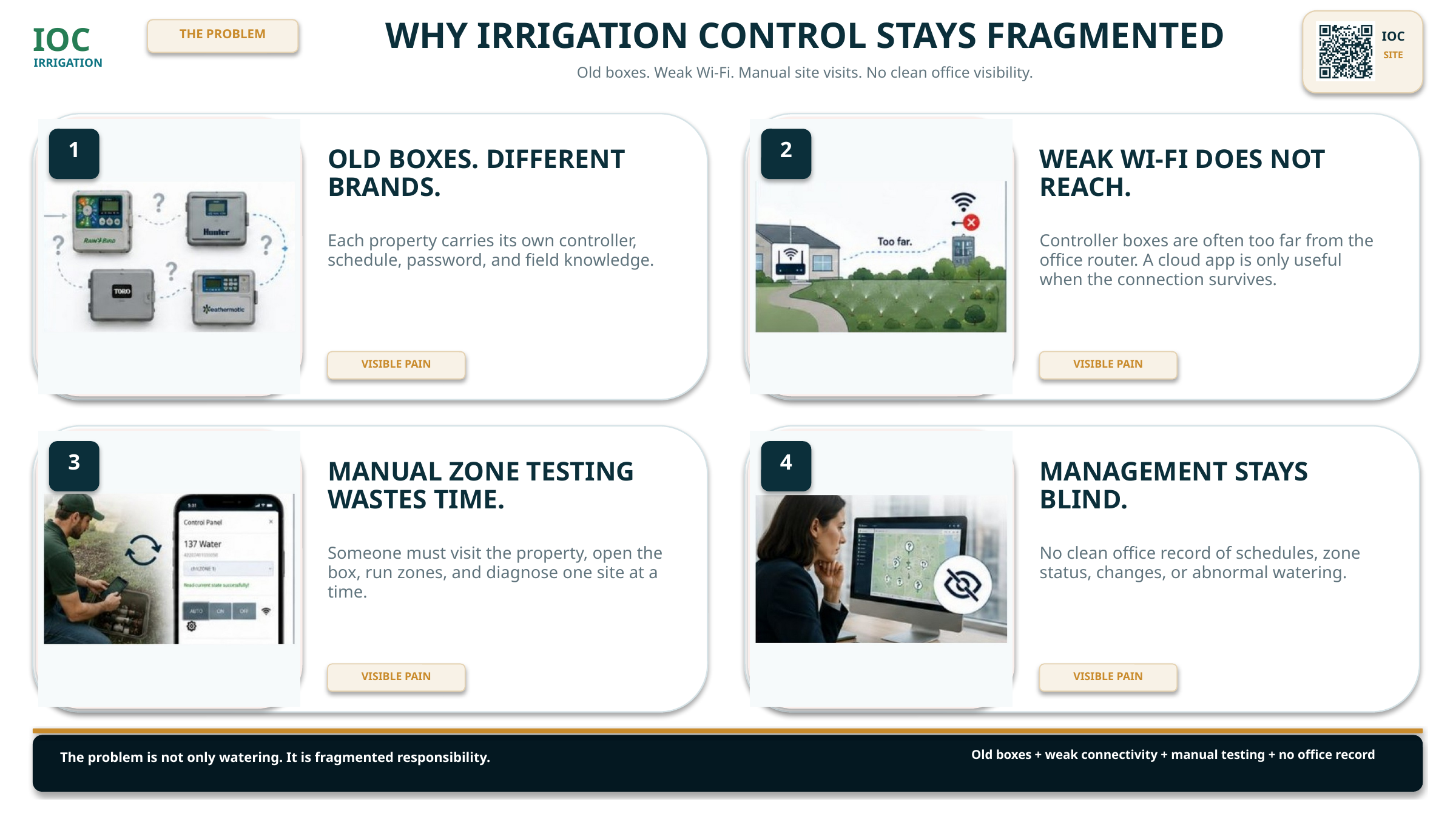
Controller problems usually land on the gardener.
The property owns the controller, but you receive the call when a zone is dry, water runs too long, the schedule changed, the connection stopped working, or nobody knows whether the system returned to automatic.
IOC does not replace the gardener. It removes controller chaos around the gardener—and gives the owner a path to lower water waste, fewer unnecessary visits, and clearer control.
Scattered controllers and brands
Every property has a different box, menu, schedule, access method, and memory of what someone changed last season.
Weak or missing Wi-Fi
Controllers live outdoors, in service areas, or far from the router. A “smart” controller is not useful when the connection is unreliable.
Manual zone testing
Turn on the zone, walk the property, inspect it, return to the box, change it, retest it, and make sure everything is back in automatic.
Schedule confusion and blame
When plants are dry, water is wasted, or a valve fails, management and the gardener often have no shared record of what actually happened.
You are not merely replacing a controller box. You are carrying field truth into an operating layer the office can see.
You are not selling another controller box. You are helping connect field knowledge to the owner and management office. Your site access, zone knowledge, and trusted property relationship make the hidden operating problem visible; IOC organizes it into a repeatable property layer.
The upgrade has to work for the gardener, management, and the property.
A field-partner program only lasts when the people doing the work, the people approving the project, and the property paying for it all receive clear value.
For the gardener
Keep the field relationship and choose the level of involvement that fits your business.
- Easier testing and authorized zone access
- Less back-and-forth to the controller box
- Less blame when schedules and zone behavior are visible
- Separate introduction, activation, and installation opportunities
- IOC handles the dashboard, activation, software, and remote support
For management
See schedules, zones, and property activity from the office instead of depending only on scattered boxes and memory.
- One clearer access path
- Schedule and zone oversight
- Authorized pause, testing, and control
- Fewer blind calls and unnecessary site checks
- Property and portfolio visibility
For the property
Reuse suitable field infrastructure while reducing the recurring cost and burden of irrigation operation.
- Lower avoidable water waste
- Less labor and fewer unnecessary visits
- No dependence on property Wi-Fi
- Modular expansion and cleaner responsibility
- A repeatable operating standard across the portfolio
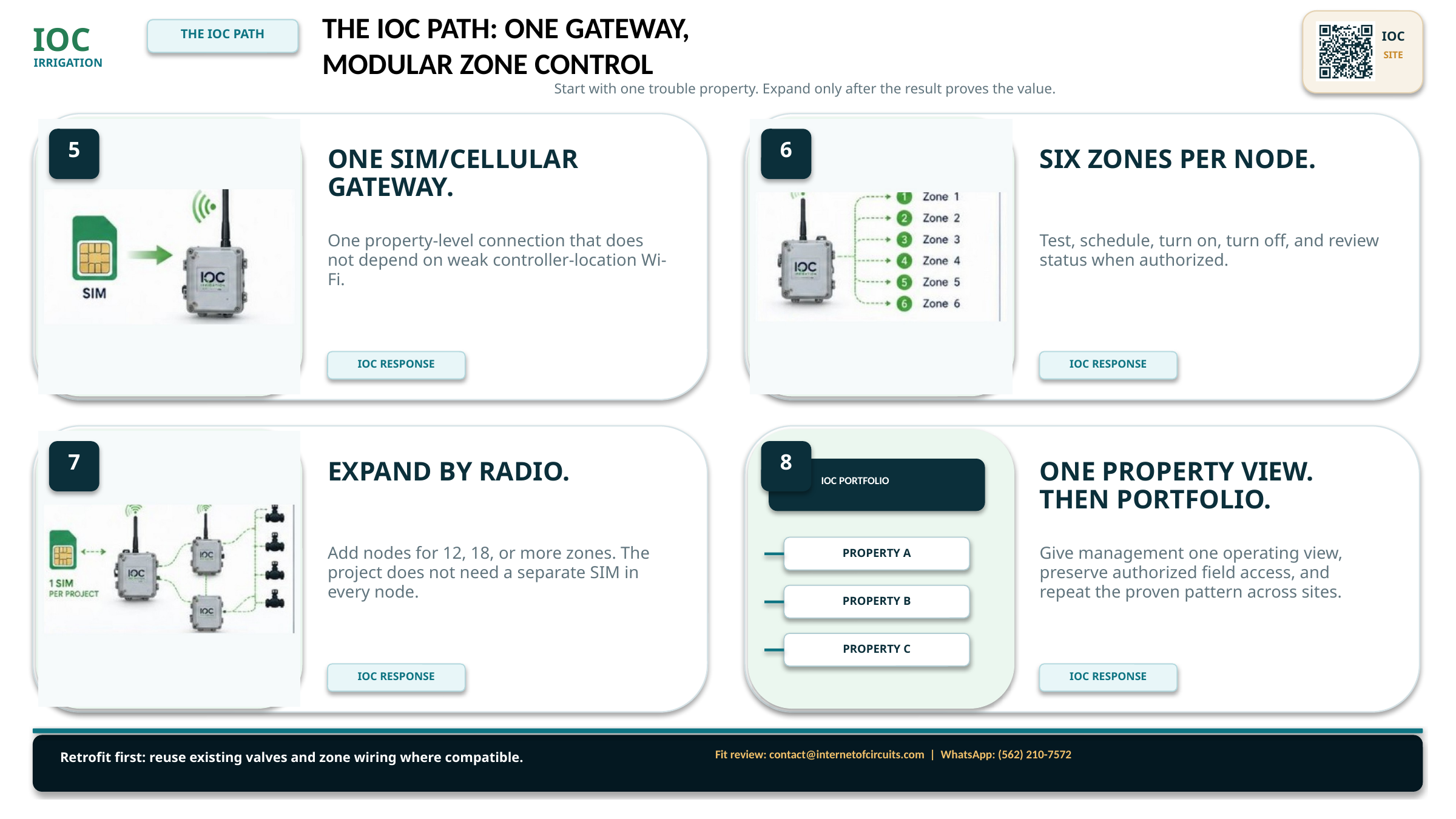
Start with one controller. Add zones without adding one SIM to every node.
One cellular gateway connects the property or project. Local radio-linked nodes can expand the same system across additional zones where the site and radio conditions are suitable. The owner does not have to replace every valve, wire, or controller location to begin.
The office gets visibility. The gardener keeps useful field control.
IOC should not take the field away from the person maintaining the landscape. It should give each side the access needed for its own job.
Owner / Manager access
- See controller and zone status from the office
- Review schedules and property-level irrigation activity
- Pause or approve authorized irrigation actions
- Reduce dependence on scattered controller memory
- Move toward a more consistent portfolio standard
Gardener / Field access
- Test selected zones during service visits
- Turn authorized zones on or off
- Return the system to automatic operation
- Flag valve, wiring, coverage, or field problems
- Support the client without becoming the software help desk
One property. One approved role. One verified result.
The first project stays understandable because the property, partner role, technical scope, compensation, and closeout are defined before field work begins.
Identify
Choose one property and state whether you are introducing, coordinating activation, installing, or combining roles.
Capture
Send authorized controller photos, zone wires, power source, enclosure, location, approximate zones, and the visible problem.
Confirm
IOC reviews the owner contact, equipment, communications, node count, role, scope, price, compensation, and activation plan.
Install and coordinate
Complete only the approved work, label zones, test the field condition, coordinate access, and document what happened.
Activate and close
IOC configures access and support while the partner confirms operation, return to automatic, customer handoff, and the next property question.
Know what the owner receives—and what one successful property can open.
The current property offer
You carry one clear six-zone property entry. IOC confirms compatibility, exact scope, customer terms, and your approved role before the property commits.
- One completed IOC node supporting up to six compatible existing irrigation zones
- One property-level SIM/cellular gateway with radio-linked expansion
- Office visibility with authorized gardener or maintenance access
- Activation, commissioning, schedules, Rain Action, remote testing, history, updates, and routine support
Why the first irrigation result matters
A successful controller upgrade can reduce water and site burden, give management a clearer operating record, and reveal where the same problem repeats.
- One controller can open more zones and more irrigation locations at the same property
- One verified result can open other buildings under the same owner or manager
- Lower water waste, fewer visits, and clearer control create recurring property value
- The same owner relationship may later review lighting, reset and recovery, pumps, or other IOC boundaries
Compensation follows the role you actually complete.
A strong partner may only open the owner relationship, may carry the first activation, may perform the physical installation, or may combine those roles. IOC records the work separately so the owner sees one organized team and the partner is paid for completed value.
How the first-property economics work
The relationship amount is not payment for a name alone. Under written terms it may recognize the trusted introduction, authorized property capture, owner coordination, and successful first activation.
Six questions that matter
A strong candidate can usually answer most of these without a long application.
One completed property can create three kinds of repeat work.
The first result can expand vertically through more zones and controllers, horizontally through more properties, and economically through lower water, labor, visit, and service burden.
Every additional property remains a separately approved project. But a clean first result makes the next owner decision, the next field installation, and the next portfolio conversation easier.
Send one real property candidate.
Use the questions beside it to prepare the first property. You can apply as the relationship opener, activation partner, field installer, or a combined role.
No commitment yet
IOC reviews the property, partner role, installation responsibility, equipment fit, communications, scope, price, and approved compensation before field work begins.
One relationship. One property. One controller.
Open the owner door and stop there, help carry the first activation, install the approved system, or combine the roles. Send the relationship, controller facts, photos, property type, city, approximate zones, and the problem the property wants solved.